Tourism with dignity: the people who walk Peru deserve rights.
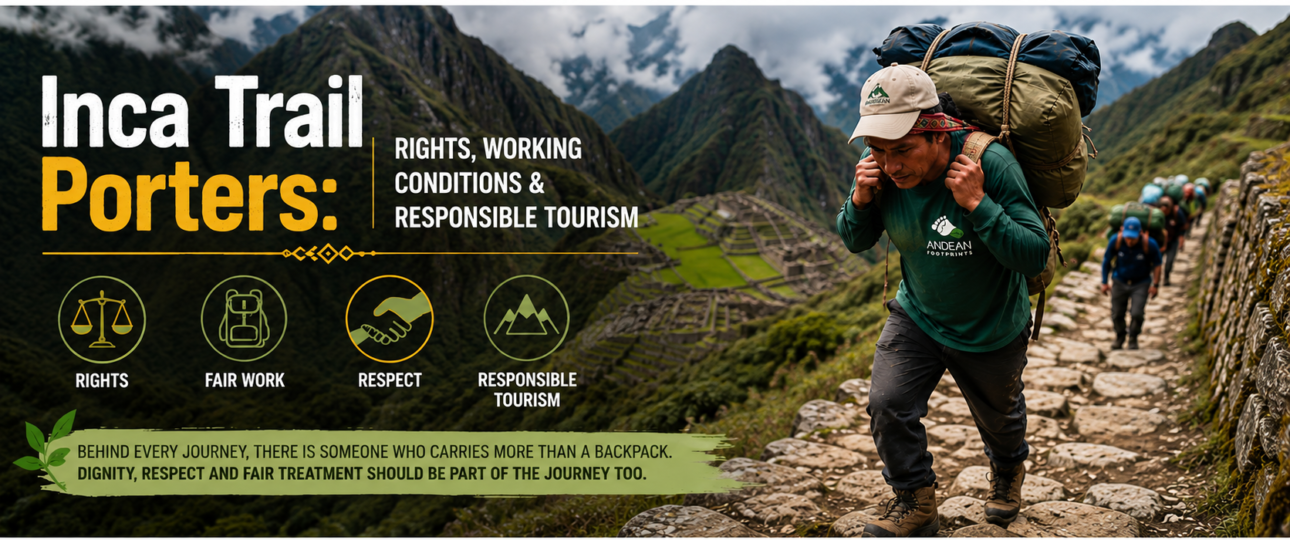
Every year, thousands of travelers hike the Inca Trail to Machu Picchu, as well as the Salkantay, Choquequirao, and other Andean routes. Along the way, Inca Trail porters carry tents, food, cooking equipment, and sometimes travelers’ personal belongings.
But who carries the weight behind the perfect mountain photograph?
Inca Trail porters walk for miles at altitudes above 3,000 meters, working on steep and uneven terrain and often facing rain, cold, hail, or intense sun. Their work is essential to many trekking experiences in Peru, yet their working conditions and legal rights are often overlooked.
This article aims to raise awareness about Inca Trail porter rights, working conditions, and responsible tourism in Peru, while calling on travel agencies, government institutions, and travelers to support a more responsible and dignified tourism industry.
The History of Peru’s Porter Law
For decades, porter work on trekking routes in Peru existed under difficult and often informal conditions.
On December 6, 2001, Peru enacted Law No. 27607, known as the Porter’s Law, establishing a legal framework for porter work and recognizing the need for protections related to their working conditions.
More than two decades later, Peru adopted Law No. 31614, the New Law of the Porter Worker, in 2022. The legislation strengthened protections related to working conditions, maximum loads, remuneration, rest, insurance, and occupational safety. The law formally recognized the importance of protecting workers who transport supplies and equipment during tourism expeditions.
The law was subsequently modified by Law No. 32137 in 2024, which changed provisions concerning the working conditions and working hours of porters. The amended law established that the porter works during the specific expedition or journey and that the working schedule should not exceed 48 hours per week.
The message behind these regulations remains simple:
Carrying someone else’s backpack should never mean losing your own dignity.
The challenge is no longer simply creating regulations. It is ensuring that they are properly understood, respected, monitored, and enforced.
Inca Trail Porter Weight Limits and Working Conditions
Porter work involves significant physical effort, particularly because it takes place at high altitude and across demanding mountain terrain.
Under the porter regulations, the maximum load is:
- Men: up to 20 kg
- Women: up to 15 kg
The Ministry of Culture explained these limits when the New Law of the Porter Worker was introduced, emphasizing the importance of protecting the physical integrity of workers.
However, responsible trekking should go beyond simply asking whether a load is technically within the legal limit.
Travel agencies should consider how equipment is distributed, how long porters work each day, the terrain, weather conditions, appropriate equipment, rest, food, insurance, and overall working conditions.
A legal maximum should be understood as a limit, not a target.
Five Urgent Issues for Inca Trail Porters
1. Enforce Inca Trail Porter Weight Limits
Respecting the legal weight limit should be a fundamental part of responsible trekking.
Weighing equipment at the beginning of a trek is important, but responsible agencies should also have internal procedures to ensure that additional loads are not transferred to Inca Trail porters during the expedition.
Travelers can help by asking their agency:
- How are porter loads weighed?
- What is included in the porter load?
- Who verifies the weight?
- What happens if a load exceeds the permitted limit?
Transparency should be part of every responsible trekking operation.
2. Create a Clear Emergency Protocol for Porters
A porter who suffers an accident, injury, altitude-related problem, or other medical emergency on the trail needs an immediate response.
Every trekking operation should have:
- Appropriate first-aid equipment.
- Staff trained to respond to emergencies.
- A clear evacuation procedure.
- Communication with relevant trail authorities and emergency services.
- Appropriate insurance coverage.
- An internal system for documenting and reporting incidents.
Emergency procedures should protect every member of a trekking team, not only the traveler who purchased the tour.
3. Ensure Fair and Timely Pay for Tourism Workers
Inca Trail porters perform physically demanding work and should receive fair and transparent compensation for their services.
Tourist tips can be an important expression of appreciation, but tips should never replace an agency’s responsibility to properly compensate its workers.
Responsible tourism means understanding the difference between a gratuity and a worker’s required remuneration.
Agencies should also avoid informal deductions that unfairly reduce a porter’s earnings.
4. Reduce Porter Loads Through Better Trekking Logistics
Responsible trekking is not simply about counting kilograms.
Good logistics can also reduce unnecessary physical strain.
Agencies can improve porter working conditions through:
- Better distribution of equipment.
- Efficient group logistics.
- Appropriate backpacks and support equipment.
- Suitable clothing and footwear.
- Proper food and hydration.
- Reasonable trekking schedules.
- Adequate rest periods.
- Avoiding unnecessary equipment.
Every kilogram that can be eliminated from a load is one less kilogram that someone has to carry up a mountain.
5. Strengthen Oversight and Responsible Tourism Standards
Tourism organizations, certification programs, and responsible-tourism initiatives can play an important role in encouraging better labor practices.
Responsible tourism in Peru should not only measure environmental impact. It should also consider the people who make tourism possible.
A trekking company should be evaluated not only by the landscapes it visits or the experiences it sells, but also by how it treats its guides, porters, cooks, drivers, and other workers.
A sustainable tourism industry should protect both people and places.
Working Conditions for Tourism Workers in Peru
The conversation about dignified tourism cannot stop with mountain porters.
Tourism depends on a much larger network of workers whose efforts are often invisible to travelers.
Travel Agency Staff
Office and operations staff may be responsible for answering questions, coordinating logistics, responding to emergencies, and supporting travelers before, during, and after their trips.
Clear working hours, fair compensation, and appropriate rest should also apply to these workers.
Tour Guides
Guides are responsible for much more than explaining archaeological sites.
They manage groups, coordinate logistics, respond to emergencies, interpret local culture, and often work long and demanding days.
Seasonality should never become an excuse for ignoring appropriate labor protections.
Trekking Cooks
Trekking cooks play a fundamental role in expedition logistics.
They prepare meals, manage food supplies, work in difficult environments, and may also participate in transporting equipment.
Their contribution deserves the same respect and attention given to other members of the trekking team.
Hotel, Transportation, and Customer-Service Workers
Tourism is a chain.
Hotels, restaurants, transportation companies, agencies, guides, Inca Trail porters, cooks, and many other workers contribute to a traveler’s experience.
Improving tourism means improving conditions throughout that chain.
A responsible tourism industry should promote:
- Fair and transparent wages.
- Appropriate working hours.
- Formal employment where applicable.
- Reasonable rest periods.
- Accessible complaint mechanisms.
- Respectful treatment in the workplace.
How Travelers Can Support Responsible Tourism on the Inca Trail
Responsible tourism does not begin and end with the travel agency.
Travelers also have a role to play.
Before booking an Inca Trail trek, ask your agency how it treats its Inca Trail porters and whether it follows the applicable regulations.
A responsible agency should be comfortable answering questions about:
- Porter weight limits.
- Worker compensation.
- Insurance.
- Equipment.
- Meals.
- Rest periods.
- Emergency procedures.
- Environmental practices.
Pack Lighter
Think carefully about what you actually need.
Every unnecessary kilogram adds weight to the trekking operation and can ultimately increase the physical burden placed on workers.
For example, Andean Footprints recommends limiting the personal load carried during its 4-day Inca Trail experience. The company currently recommends approximately 5 kg in the traveler’s daypack and 7 kg in the duffel carried by porters.
Keep the Trail Clean
Never leave trash on the Inca Trail.
Carry your own waste until you reach an appropriate disposal point, and avoid unnecessary single-use items whenever possible.
Protecting the environment is part of protecting the people who work in it.
Treat Tips as a Bonus, Not a Substitute for Fair Pay
Tips can be a meaningful way to thank Inca Trail porters, guides, cooks, and other members of a trekking team.
But tipping should complement fair compensation, not replace it.
Ask Questions Before Booking
One of the most powerful things travelers can do is ask questions before paying for a trek.
If an agency is committed to Inca Trail responsible tourism, it should be willing to explain how it protects its workers.
Your questions can help create demand for better standards throughout the industry.
Choosing a Responsible Inca Trail Operator
Before booking, travelers should look beyond price and ask how the company manages its trekking teams.
A responsible trekking operator should be transparent about:
- Porter load policies.
- Group sizes.
- Safety procedures.
- Staff experience.
- Environmental practices.
- Worker treatment.
- Emergency procedures.
- Transparency about what is included.
For travelers interested in experiencing the classic route, you can learn more about the 4-Day Inca Trail to Machu Picchu offered by Andean Footprints.
For travelers with less time, the 2-Day Inca Trail to Machu Picchu provides a shorter route while still reaching Machu Picchu through the historic trail.
And if you want to learn more about the company’s approach to social responsibility, visit the Social Responsibility section of Andean Footprints.
Discrimination and Access to Machu Picchu
Responsible tourism also involves equal and respectful treatment by the institutions and companies that manage access to Peru’s most important tourist destinations.
Questions surrounding transportation, ticketing, pricing, access, and customer service deserve transparency and public discussion when they affect tourism workers and local communities.
Companies operating transportation services to Machu Picchu, as well as institutions responsible for the Historic Sanctuary and the archaeological site, have an important responsibility toward both travelers and the people who work within the tourism system.
This includes porters, guides, cooks, drivers, tourism staff, local residents, and other workers whose livelihoods depend on tourism.
A genuinely inclusive tourism system should promote:
- Transparency in ticketing, access, and allocation systems.
- Participation from tourism workers and local stakeholders in decisions that affect them.
- Accessible complaint mechanisms for workers and residents.
- Equal and respectful treatment in facilities and customer-service environments.
- Clear public information about policies that affect access to Machu Picchu.
Machu Picchu is a World Heritage destination, but it is also part of the home, history, and economy of the people who live and work in Peru.
Respect should not depend on whether someone is carrying a foreign passport, a Peruvian ID, or a 20-kilogram backpack.
A Call for More Responsible Tourism in Peru
To Travel Agencies
Respecting porter regulations and improving working conditions should not be seen simply as a cost.
It is an investment in the sustainability, reputation, and future of the tourism industry.
Responsible trekking means creating experiences that are positive not only for travelers, but also for the people who make those experiences possible.
To Government Institutions
Effective regulation requires more than written laws.
Inspection, transparency, accessible complaint systems, and meaningful enforcement are essential to ensuring that regulations protect workers in practice.
To International Tourism Organizations
International tourism organizations and responsible-tourism certification programs can help promote stronger standards by encouraging companies to demonstrate how they treat their workers.
Sustainability should include both environmental responsibility and social responsibility.
To Travelers
Get informed.
Ask questions.
Pack responsibly.
Respect the trail.
Treat workers with dignity.
And choose companies that are willing to explain how they protect the people behind your journey.
Tourism With Dignity
The Inca Trail has been walked for centuries.
Today, thousands of people continue to travel through the Andes in search of history, culture, adventure, and connection with Peru.
But behind every unforgettable trekking experience are people who wake up early, carry equipment, prepare food, build camps, guide travelers, solve problems, and make the journey possible.
Inca Trail porters deserve to be seen.
They deserve to be respected.
And they deserve to work under conditions that protect their rights and dignity.
Responsible tourism is not a symbolic gesture. It is a series of concrete decisions made by agencies, institutions, workers, and travelers.
Every step matters.
And so does the person carrying the weight behind it.